
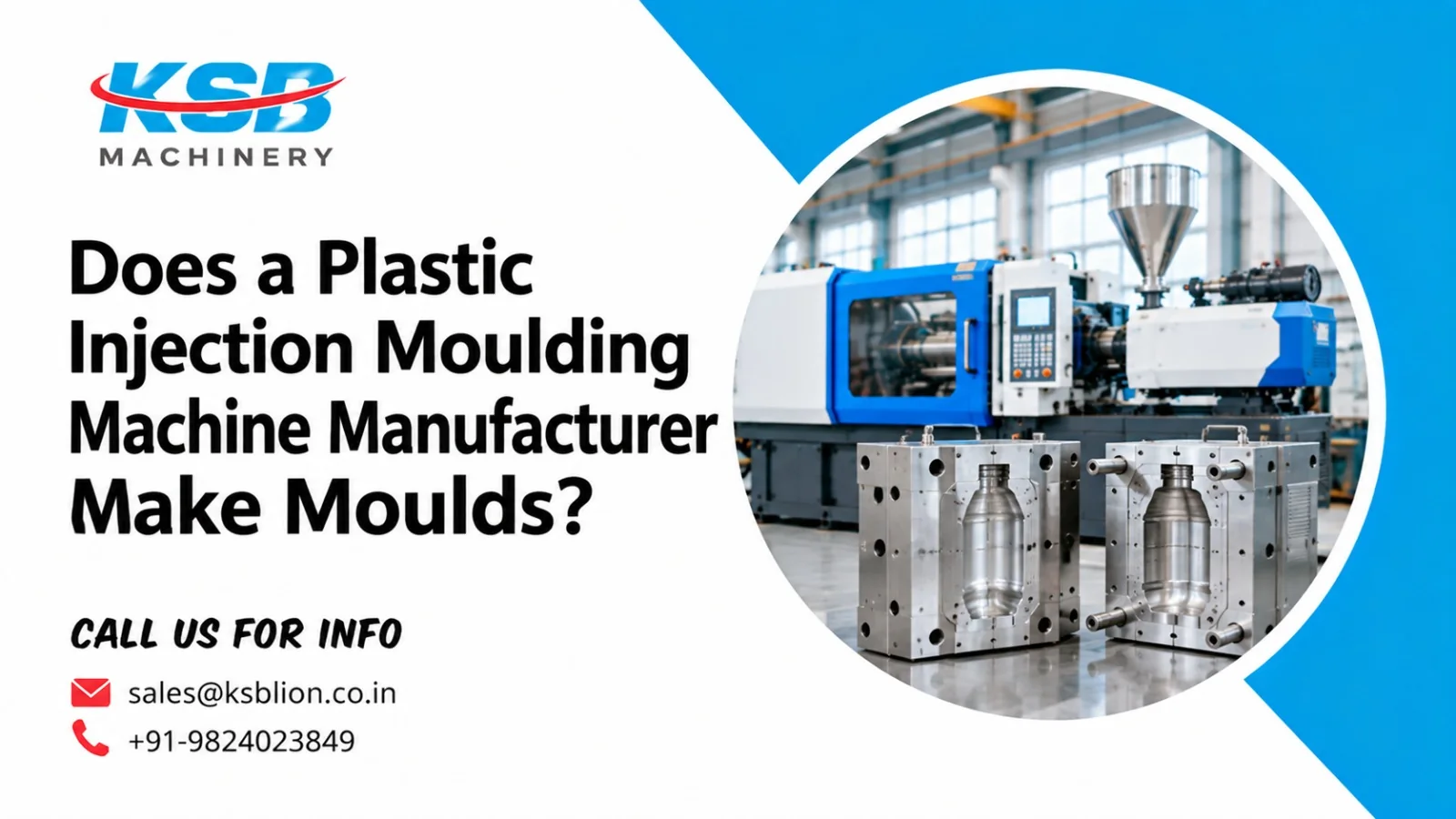
usually no. The machine and the mould come from two different skills, and the two must fit each other.
A Plastic Injection Moulding Machine Manufacturer builds the machine. The mould is normally built by a separate mould maker, also called a tool room. Some companies offer both, so ask before you order. What matters most is that the mould fits the machine.
Key Takeaways
- Machine makers build machines. Mould makers build moulds.
- A mould must match the machine’s tie-bar spacing, mould height, opening stroke and clamping force.
- A mould wider than the tie-bar clearance cannot be mounted, whatever the tonnage.
- Share your machine data with the mould maker before the mould is made.
- Ask each supplier in writing what is and is not included.
Introduction
Many new buyers ask the same thing: “If I buy a machine, will the manufacturer also give me the mould?” The answer affects your budget, your timeline and who you call when something does not fit. This blog explains who makes what, how a mould and a machine match, and which questions to ask before you place an order.
Machine Manufacturer, Mould Maker and Moulder: Who Does What?
A moulding project usually involves three roles. One company can play more than one, but the jobs are different.
| Role | What they do | What you get |
| Machine manufacturer | Designs and builds the clamping unit, injection unit, drive and controller, and supports installation and service | A machine |
| Mould maker (tool room) | Designs the mould, cuts it in steel, polishes it, fits ejectors and cooling, and tests it | A mould |
| Moulder (your factory) | Runs the mould on the machine with plastic granules | Finished parts |
Some moulders have their own tool room, and some machine suppliers work with mould makers. Do not assume it. Ask.
Why Machine Makers and Mould Makers Are Usually Separate
The two jobs need different skills. Building a machine means heavy fabrication, hydraulics or servo drives, and controls. Making a mould means precision machining, steel finishing, polishing and detailed part design.
There is also a practical reason. A mould is made for one product, but a machine runs many moulds over its life. You may use the same machine for a bucket mould this year and a fitting mould next year. So it makes sense to buy the machine from a machine builder and the mould from a specialist.
How a Mould Fits a Machine
A mould sits between two platens and is held shut by the clamping unit. For it to work, six things must line up:
- Tie-bar spacing: the mould must pass between the tie bars. Ideally it fits inside them, and at the very least the projected area of the parts must be inside them.
- Mould height and opening stroke: every machine has a minimum and maximum mould height and an opening stroke. The part must clear the mould when it opens.
- Clamping force: it must hold the mould shut against injection pressure. As a rule, projected area multiplied by cavity pressure, plus a safety margin.
- Shot capacity: the parts plus the runner should sit comfortably within the machine’s shot capacity.
- Locating ring and nozzle: the locating ring aligns the mould with the machine, and the nozzle radius must seat against the sprue bushing. Many moulds use a 4-inch (101.6 mm) or 120 mm locating ring.
- Ejector pattern: the machine’s ejector rods must reach the mould’s ejector plate.
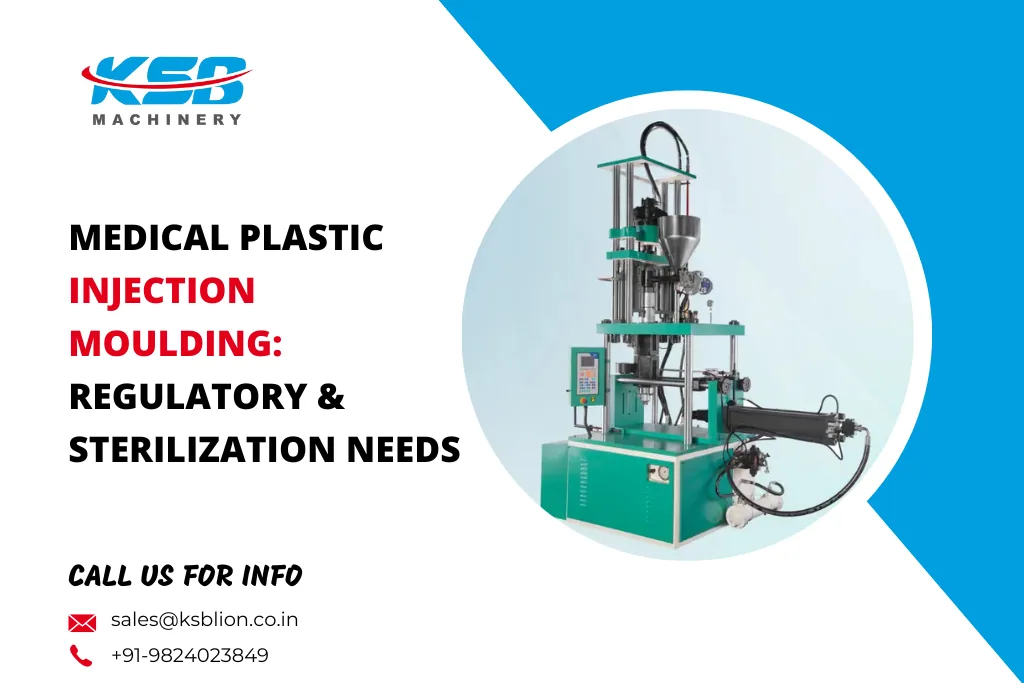
Mould weight matters too. A heavy mould needs platens that can carry it, and your factory needs a crane or lifting arrangement to move it safely. On a vertical machine the mould halves open up and down, so you must also plan how the mould is mounted and how parts are removed, by hand or with a robotic arm.
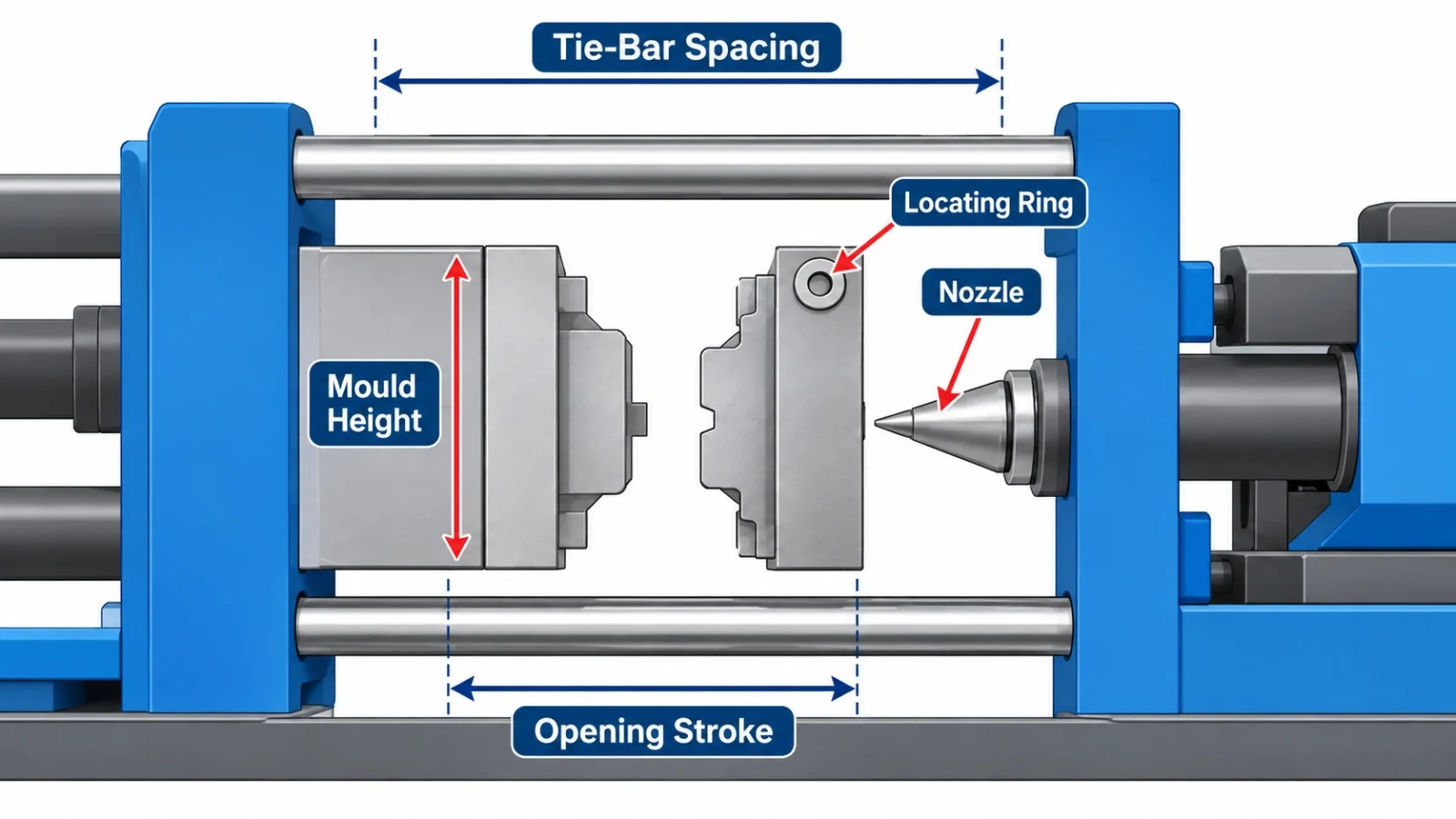
Machine Details Your Mould Maker Needs
Send this data to your mould maker before the steel is cut. It prevents most fitting problems.
| Machine detail | Why the mould maker needs it |
| Tie-bar spacing (horizontal × vertical) | The mould must pass between the tie bars |
| Platen size | The mould must sit fully on both platens |
| Minimum and maximum mould height | The mould must stay inside the machine’s range |
| Opening stroke | The part must clear the mould when it opens |
| Locating ring bore | Aligns the mould with the machine |
| Nozzle radius | Must seat against the sprue bushing |
| Ejector pattern | Ejector rods must reach the ejector plate |
| Clamping force and shot capacity | Decide how many cavities the machine can handle |
KSBLION lists 80 to 400 ton on its Horizontal Injection Moulding Machine page. The Vertical Injection Moulding Machine page lists 17 to 48 ton with 100 gm to 5 kg shot capacity. Use such ranges as a starting point, and ask for the full data sheet of the exact model.
What Goes Wrong When a Mould Does Not Fit
| Mismatch | What happens |
| Mould wider than the tie-bar clearance | It cannot be installed |
| Mould taller than the machine allows | The machine cannot close or open properly |
| Wrong locating ring or nozzle radius | Poor alignment and leaks at the sprue |
| Clamping force too low | Flash on the parts |
| Shot too large for the machine | Short or inconsistent parts |
Most of these are checked on paper in a few minutes. Fixing them after the mould is made can cost far more.
Buying a Machine and a Mould: What to Ask
Before you order, put these questions to every supplier:
- Who makes the mould, and who is responsible for the mould trial?
- Will the machine supplier share a data sheet with the mould maker?
- Who owns the mould drawings and the finished mould?
- If the mould does not fit, who fixes it and who pays?
KSBLION is a machine manufacturer and service provider in Ahmedabad, working since 1998. If you already have a mould or a drawing, share the mould size, weight, material and number of cavities when you contact our team, and we will help you choose a machine that suits it. If you are still deciding on tooling, read about multi-cavity vs family moulds before you brief your mould maker.
Looking After Your Moulds
A good mould lasts for years if you treat it well:
- Clean and dry the mould after every run, then apply a rust preventive.
- Keep cooling channels free of scale and blockage.
- Lubricate guide pins and check ejector pins regularly.
- Store moulds on racks, with the faces closed and covered.
- Use proper lifting eyebolts and keep a shot count for each mould.
Safety and Compliance Note
Moulds are heavy and have sharp edges. Use rated lifting equipment, keep hands and tools out of the mould area while the machine is running, and never bypass safety guards or interlocks. Follow the machine manual and your factory’s safety rules, and wear proper protective equipment. This blog gives general information and does not replace the machine or mould supplier’s instructions.
FAQs
Does an injection moulding machine come with a mould?
Usually not. The machine and the mould are normally bought separately. Confirm this in writing before you order.
Who makes moulds for injection moulding machines?
Specialist mould makers, also called tool rooms, design and build moulds. Some moulders also run their own tool rooms.
Can one mould run on different machines?
Yes, if the tie-bar spacing, mould height, opening stroke, locating ring, nozzle, clamping force and shot capacity all match. Check each point before moving a mould.
How do I know what machine size my mould needs?
Work out the clamping force from the projected area and cavity pressure, and check that the shot capacity covers parts plus runner. Then confirm that the mould fits the tie bars and mould-height range.
Who is responsible if the mould does not fit the machine?
It depends on who supplied the data and what you agreed. Decide this in writing before the order, and share the machine data sheet early.
Can I use an old mould on a new machine?
Often yes, if the checks match. Look closely at the locating ring, nozzle radius and ejector pattern, and inspect the mould’s condition before the trial.
Conclusion
A plastic injection moulding machine manufacturer builds the machine, and a mould maker builds the mould. The two come together on your shop floor, so the details must match before either is made. Collect the tie-bar spacing, mould height, stroke, locating ring and nozzle data first, and share them with your mould maker. At KSBLION, we have built injection moulding machines in Ahmedabad since 1998, and our team helps buyers match a machine to the mould and product they plan to run. Ask each supplier what is included, agree on responsibility in writing, and run a mould trial before regular production begins.