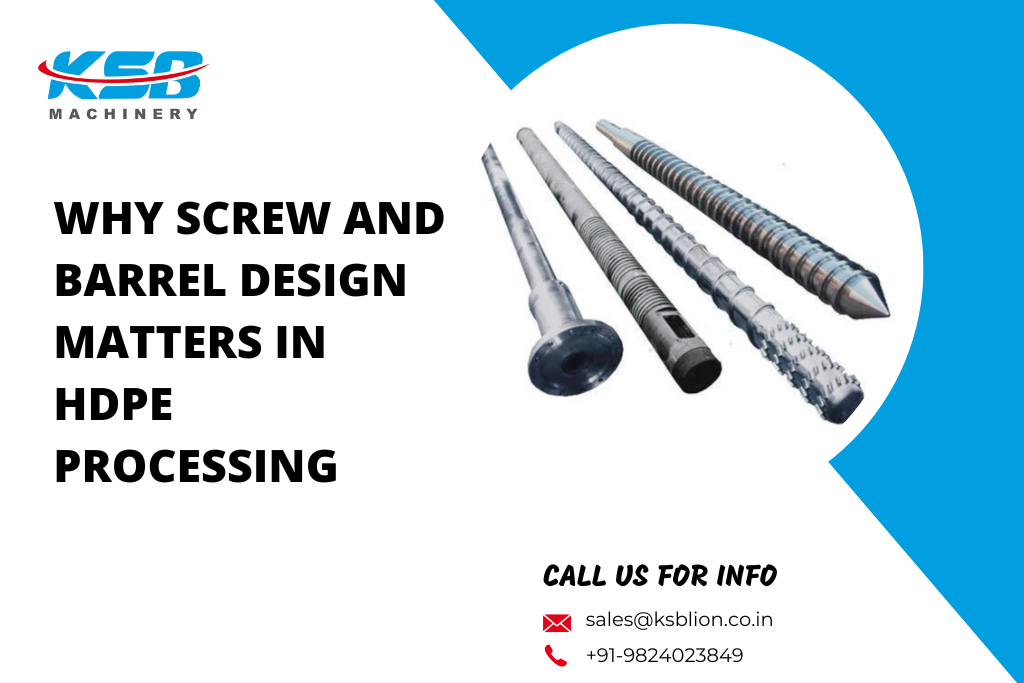
High-Density Polyethylene (HDPE) is one of the most widely used thermoplastics in injection moulding due to its strength, chemical resistance, and versatility. However, achieving consistent quality, optimal cycle time, and minimal waste depends heavily on one critical factor: HDPE screw and barrel design.
For manufacturers working with an HDPE Injection Moulding Machine Manufacturer or any Injection Moulding Machine Manufacturer, understanding how screw and barrel geometry affects processing performance is essential for productivity and long-term machine efficiency.
Understanding HDPE Processing Requirements
HDPE has unique processing characteristics compared to other polymers. It features:
- High crystallinity
- Narrow processing temperature window
- Sensitivity to shear and melt homogeneity
- Tendency for shrinkage if not processed correctly
Because of these properties, generic screw designs often fail to deliver optimal results. Specialized HDPE injection moulding screw design ensures uniform melting, stable pressure, and consistent part quality.
Role of Screw and Barrel in HDPE Injection Moulding
The screw and barrel are the heart of any injection moulding system. Among all HDPE processing machine components, they play the most direct role in melting, mixing, and conveying the polymer.
A well-designed screw and barrel system ensures:
- Uniform melt temperature
- Proper shear distribution
- Consistent shot-to-shot repeatability
- Reduced material degradation
Poor design, on the other hand, can lead to defects such as flow lines, voids, warpage, and inconsistent mechanical strength.
Key Elements of HDPE Screw and Barrel Design
1. Screw Geometry and Compression Ratio
HDPE typically requires a medium compression ratio to balance melting efficiency and shear sensitivity. Proper HDPE injection moulding screw design prevents overheating while ensuring complete melting.
2. Feed, Compression, and Metering Zones
Each zone must be optimized for HDPE’s flow behavior. A longer compression zone helps improve melt homogeneity, while a stable metering zone ensures consistent injection pressure.
3. Screw Length-to-Diameter (L/D) Ratio
An appropriate L/D ratio allows sufficient residence time for HDPE to melt uniformly without degradation. Most HDPE applications perform best with customized L/D configurations rather than standard designs.
4. Barrel Material and Wear Resistance
HDPE may contain additives or fillers that increase wear. High-quality barrel materials with proper surface treatment improve longevity and reduce maintenance downtime.
Impact on Productivity and Cycle Time
Optimized HDPE screw and barrel design directly influences cycle time and output. Efficient melting reduces heating time, while consistent material flow minimizes rejected parts.
Benefits include:
- Faster cycle times
- Lower energy consumption
- Improved dimensional stability
- Reduced machine wear
For manufacturers sourcing equipment from an Injection Moulding Machine Manufacturer, screw and barrel customization should be a key consideration rather than an afterthought.
Quality Consistency and Part Performance
In HDPE moulding, even slight inconsistencies in melt quality can affect:
- Surface finish
- Wall thickness uniformity
- Impact strength
- Shrinkage behavior
A well-engineered screw ensures consistent back pressure and uniform mixing, which improves overall part performance. This is especially critical for applications such as containers, caps, pipes, and industrial components.
Importance for HDPE Injection Moulding Machine Manufacturers
Reputed HDPE Injection Moulding Machine Manufacturers prioritize screw and barrel optimization because it directly affects customer satisfaction and machine reliability. Machines designed with application-specific screws perform better across a wider range of HDPE grades.
Leading manufacturers often offer:
- Customized screw designs based on product application
- Wear-resistant barrel coatings
- Technical support for process optimization
These features differentiate high-quality machines from standard, generic systems.
Integration with Other HDPE Processing Machine Components
While screw and barrel design is critical, it must work in harmony with other HDPE processing machine components such as:
- Heaters and temperature controllers
- Injection and clamping units
- Hydraulic or servo systems
- Mould design and cooling channels
A balanced system ensures stable processing, higher uptime, and predictable output.
Long-Term Cost and Maintenance Benefits
Investing in the right HDPE injection moulding screw design reduces long-term operational costs by:
- Minimizing material waste
- Reducing screw and barrel wear
- Lowering energy consumption
- Decreasing machine downtime
Over time, this translates into higher profitability and better return on investment for moulding operations.
Conclusion
The performance of HDPE injection moulding processes depends heavily on HDPE screw and barrel design. From melt quality and cycle time to energy efficiency and part consistency, the screw and barrel influence nearly every aspect of production.
Manufacturers working with a reliable Injection Moulding Machine Manufacturer or HDPE Injection Moulding Machine Manufacturer should prioritize application-specific screw and barrel configurations. When combined with high-quality HDPE processing machine components, the right design ensures efficient production, superior part quality, and long-term operational success.
Choosing the correct screw and barrel is not just a technical decision—it’s a strategic investment in productivity and reliability.