Pushing the Boundaries of Modern Manufacturing
The world of manufacturing is constantly evolving. As products become smaller, lighter, and more functional, the need for high precision plastic moulding has grown dramatically. Industries like electronics, automotive, and medical devices now demand ultra-fine components that traditional moulding methods can’t achieve.
That’s where micro-moulding-the next stage in injection moulding innovation-comes in. Using advanced technology and precision engineering, manufacturers can now produce microscopic parts with exceptional detail, accuracy, and consistency.
What Is the Micro Injection Moulding Process?
The micro injection moulding process is a specialized form of plastic moulding used to create extremely small parts, often weighing less than one gram. These components may feature walls as thin as 0.1 mm, yet must maintain structural strength and dimensional accuracy.
Unlike standard moulding, this process requires:
- High-performance polymers capable of maintaining flow in ultra-thin sections.
- Precision tooling with micron-level tolerances.
- Advanced control systems that monitor temperature, pressure, and injection speed to the smallest detail.
This technique allows manufacturers to produce medical components, miniature gears, optical parts, and micro-connectors with incredible reliability-a huge step forward for industries that rely on compact yet durable components.
Role of the Plastic Injection Moulding Machine
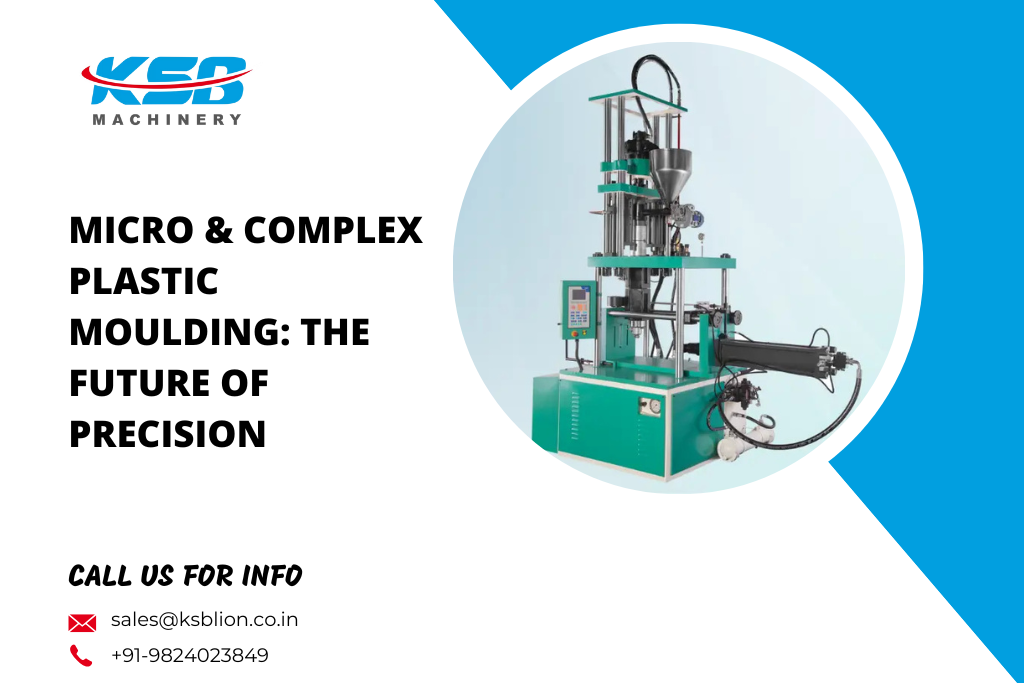
Behind every successful moulded component is an advanced plastic injection moulding machine. In micro-moulding, the machines are smaller but far more precise, capable of maintaining consistent parameters throughout the production cycle.
Modern micro-moulding machines feature:
- High-resolution injection units that control material flow with pinpoint accuracy.
- Servo-driven systems for stable clamping and reduced cycle time.
- Automated feedback systems to correct minor deviations in real time.
Leading injection moulding machine manufacturers have developed micro-specific machines with tighter process control, specialized screws and barrels, and energy-efficient drives to meet growing industry demands.
These machines help achieve consistent part quality even when producing thousands of micro components per day.
Why High Precision Plastic Moulding Matters
In today’s competitive market, every millimeter counts. High precision plastic moulding ensures that every part – no matter how small – fits perfectly into the final product.
Here’s why it’s a game-changer:
- Dimensional Accuracy: Tight tolerances ensure parts align seamlessly in complex assemblies.
- Enhanced Durability: Uniform material flow and pressure prevent weak points or warping.
- Aesthetic Perfection: Precision control means smoother surfaces and minimal finishing.
- Material Efficiency: Less waste and shorter cycles reduce production costs and environmental impact.
From hearing aids and surgical tools to miniature sensors and mobile connectors, precision moulding drives innovation in industries where quality cannot be compromised.
Complex Plastic Injection Moulding: Meeting the Toughest Design Challenges
Modern products are not only smaller – they’re also more complex. Designers now integrate multiple functions into a single component, creating intricate shapes and thin walls that test the limits of traditional moulding.
Complex plastic injection moulding addresses these challenges through multi-component and insert-moulding techniques. Engineers can combine different materials, colors, or mechanical properties within one part – without assembly.
Some key examples include:
- Two-shot moulding: Combining hard and soft materials for ergonomic or sealed parts.
- Overmoulding: Creating durable seals or grip surfaces over rigid structures.
- Insert-moulding: Embedding metal pins or electronic components directly into plastic parts.
Such advanced processes help reduce assembly time, improve reliability, and deliver cost-effective, ready-to-use parts.
Future: Smart and Sustainable Moulding
The next generation of injection moulding will integrate Industry 4.0 technologies — connecting machines, sensors, and data analytics to optimize every stage of production.
AI and automation will enable predictive maintenance, while IoT-enabled moulding machines will provide real-time performance insights. This ensures zero defects, minimal downtime, and consistent product quality.
At the same time, sustainability is becoming a key driver. Many injection moulding machine manufacturers now focus on:
- Using bio-based or recycled materials for eco-friendly parts.
- Improving energy efficiency through servo-electric drives.
- Reducing cycle times without compromising quality.
These innovations make injection moulding not only more advanced but also more responsible – paving the way for greener manufacturing.
Applications of Micro and Complex Moulding
The micro injection moulding process has found success across multiple industries:
- Medical Devices: Micro-catheters, surgical tools, diagnostic components.
- Electronics: Micro-connectors, switches, and optical lenses.
- Automotive: Miniature gears, sensors, and precision clips.
- Aerospace: Lightweight, high-strength micro parts for advanced systems.
By combining precision engineering with cutting-edge materials, manufacturers can create parts that were once considered impossible.
Conclusion
The world of micro-moulding and complex plastic injection moulding is redefining what’s possible in manufacturing. With continuous innovation in plastic injection moulding machines and smarter designs from leading injection moulding machine manufacturers, industries are producing stronger, smaller, and more precise components than ever before.
Whether it’s for life-saving medical tools or next-gen electronics, high precision plastic moulding is helping companies push boundaries, reduce waste, and deliver excellence at microscopic scales.