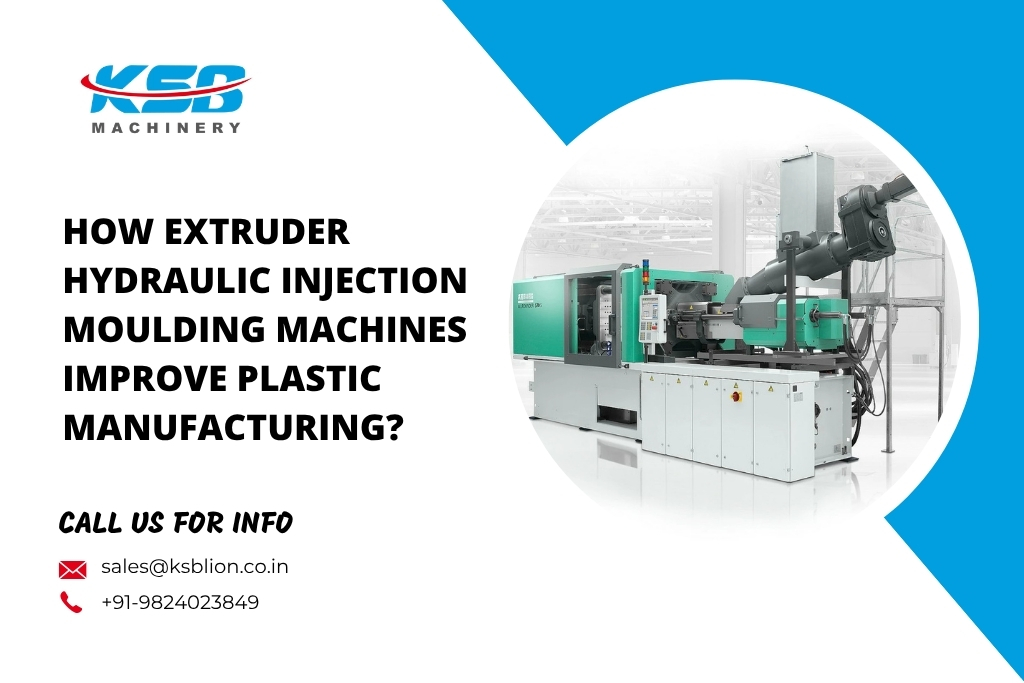
Modern plastic manufacturing requires equipment capable of handling different materials, moulds, production volumes, and product designs with consistent process control. An Extruder Hydraulic Injection Moulding Machine combines screw-based material plasticisation with hydraulic systems used for injection and mould-clamping operations.
This combination makes the machine relevant to manufacturers producing industrial, automotive, household, electrical, packaging, and other plastic components.
For manufacturers evaluating injection moulding equipment, understanding how the extruder and hydraulic systems work together can help with better machine selection.
How the Extruder System Works
The extruder section generally consists of components such as a hopper, screw, barrel, heating zones, and drive system.
Plastic granules enter through the hopper and move through the barrel as the screw rotates.
Heat and mechanical energy help transform the polymer into a molten material.
The screw also helps:
- Convey the material
- Mix the polymer
- Plasticise the material
- Build the required melt volume
- Meter material for injection
The screw and barrel configuration should be selected according to the material and production requirements.
Different polymers can have different temperature, mixing, and processing characteristics.
Why Hydraulic Power Is Important
Hydraulic systems have been widely used in industrial injection moulding because they can provide substantial force for machine movements.
In an injection moulding machine, hydraulic power can be used for:
- Injection
- Mould clamping
- Ejection
- Core movements where applicable
- Other hydraulic machine functions
The hydraulic system converts hydraulic pressure into controlled mechanical movement.
This allows the machine to perform the high-force operations required during moulding.
Understanding Injection and Pressure Control
During injection, molten plastic is pushed from the barrel into the mould cavity.
The injection process needs to be controlled carefully because pressure, speed, temperature, and material behaviour can influence the final component.
After the cavity is filled, a holding or packing stage can help compensate for material shrinkage as the plastic cools.
The exact settings depend on:
- Polymer type
- Product geometry
- Mould design
- Wall thickness
- Injection speed
- Temperature
- Required product quality
Proper process development is therefore important for achieving repeatable results.
The Working Cycle of the Machine
1. Material Feeding
Plastic granules are supplied through the machine hopper.
The material then enters the screw and barrel system.
2. Plasticisation
The screw rotates while heaters and mechanical energy help melt and prepare the polymer.
3. Metering
The required amount of molten material is prepared for the next injection cycle.
4. Mould Closing
The mould closes and the clamping system provides the force required to keep the mould closed during injection.
5. Injection
The molten polymer is pushed into the mould cavity.
6. Holding and Packing
Pressure is maintained for an appropriate period to support cavity filling and compensate for material shrinkage.
7. Cooling
The mould remains closed while the plastic cools and solidifies.
8. Mould Opening and Ejection
The mould opens and the finished component is removed using the mould’s ejection system.
The cycle then begins again.
Key Benefits for Plastic Manufacturers
An Extruder Hydraulic Injection Moulding Machine can provide several practical benefits when appropriately configured for a particular production application.
Consistent Production
Controlled injection and plasticisation parameters can help manufacturers produce parts with repeatable characteristics.
Consistency is especially important when producing large quantities of the same component.
Strong Injection and Clamping Capability
Hydraulic systems can provide the force needed for demanding moulding applications.
The required force depends on the mould size, projected area, material, and processing conditions.
Flexible Material Processing
A suitable screw and barrel configuration can support the processing requirements of different thermoplastics.
However, material compatibility should always be confirmed with the machine manufacturer.
Industrial Applications
Hydraulic systems are commonly used in industrial environments where robust machine operation and high-force movement are required.
Automation Compatibility
Appropriately configured machines can be integrated with auxiliary equipment such as:
- Automatic loaders
- Part-removal systems
- Conveyors
- Robots
- Material dryers
- Mould-temperature controllers
Automation can reduce manual intervention and help improve production workflow.
Why Screw and Barrel Design Matter
The screw is one of the most important components in the plasticisation process.
Its geometry influences how material is conveyed, heated, mixed, and prepared for injection.
Important considerations can include:
- Screw diameter
- Screw length-to-diameter ratio
- Screw geometry
- Compression characteristics
- Material requirements
A screw designed for one polymer or application may not be ideal for another.
For this reason, machine selection should consider the materials that will actually be processed.
Smart Process Monitoring
Process monitoring can help manufacturers identify deviations from established operating conditions.
When production data is recorded over time, manufacturers can better understand process behaviour and identify potential issues.
This creates opportunities for more data-driven manufacturing without changing the fundamental hydraulic operating principle of the machine.
Selecting the Right Extruder Hydraulic Injection Moulding Machine
Choosing a machine should begin with the actual production requirement.
Important factors include:
Clamping Force
The machine should provide adequate clamping force for the mould and application.
Injection Capacity
Shot size and injection capacity should match the volume of material required for the component and runner system.
Material
The machine should be configured appropriately for the polymers being processed.
Mould Dimensions
Mould dimensions, tie-bar spacing, mould height, and machine platen specifications should be considered.
Production Volume
Manufacturers should consider their expected cycle time and production requirements.
Automation
If automated production is planned, the machine should be compatible with the required auxiliary equipment.
Controls and Service
The control system, maintenance requirements, spare-parts availability, and technical support are also important considerations.
Explore Extruder Hydraulic Injection Moulding Solutions with KABlion
Smart Controls in Hydraulic Injection Moulding
Modern control systems can provide operators with better visibility into machine operation.
Depending on the machine configuration, controls can monitor parameters such as:
- Injection pressure
- Injection speed
- Barrel temperature
- Screw position
- Cycle time
- Hydraulic system status
- Alarm conditions
Monitoring these parameters can help operators identify process variations and maintain established production settings.
Automation and Robotic Integration
Automation is becoming increasingly common in plastic manufacturing.
An Extruder Hydraulic Injection Moulding Machine can potentially be integrated with:
- Robotic part removal
- Automatic material loading
- Conveyors
- Inspection systems
- Mould-temperature controllers
- Material dryers
- Production monitoring systems
Automation can reduce repetitive manual tasks and support a more consistent production workflow.For high-volume manufacturing, automated part handling can also help reduce interruptions between moulding cycles.
Why Preventive Maintenance Still Matters
Even with modern monitoring systems, regular maintenance remains essential.Manufacturers should follow the machine manufacturer’s maintenance recommendations.
Depending on the machine, maintenance may include checking:
- Hydraulic oil condition
- Filters
- Hydraulic hoses and connections
- Heating systems
- Screw and barrel condition
- Lubrication points
- Electrical connections
- Safety systems
Regular inspection can help maintain reliable machine operation and identify wear before it becomes a larger issue.
Improving Process Consistency
Consistent moulding requires more than a capable machine.Manufacturers should establish controlled processing conditions for the selected material and mould.
Important parameters can include:
- Melt temperature
- Injection speed
- Injection pressure
- Holding pressure
- Cooling time
- Screw speed
- Back pressure
Once suitable parameters have been established, maintaining them consistently can help reduce unwanted variation.Process monitoring can make it easier for operators to identify changes from the established production window.
Conclusion
The Extruder Hydraulic Injection Moulding Machine continues to play an important role in plastic manufacturing by combining controlled material plasticisation with hydraulic injection and clamping capabilities.
Modern developments are adding new possibilities through:
- Digital controls
- Process monitoring
- Automation
- Robotic integration
- Energy-management technologies
- Predictive maintenance
However, machine selection should always be based on the actual production application.Manufacturers should evaluate material compatibility, mould requirements, clamping force, shot size, production volume, automation, controls, maintenance, and technical support before making a decision. Ksblion can be considered by manufacturers exploring hydraulic injection moulding solutions for different plastic production requirements.