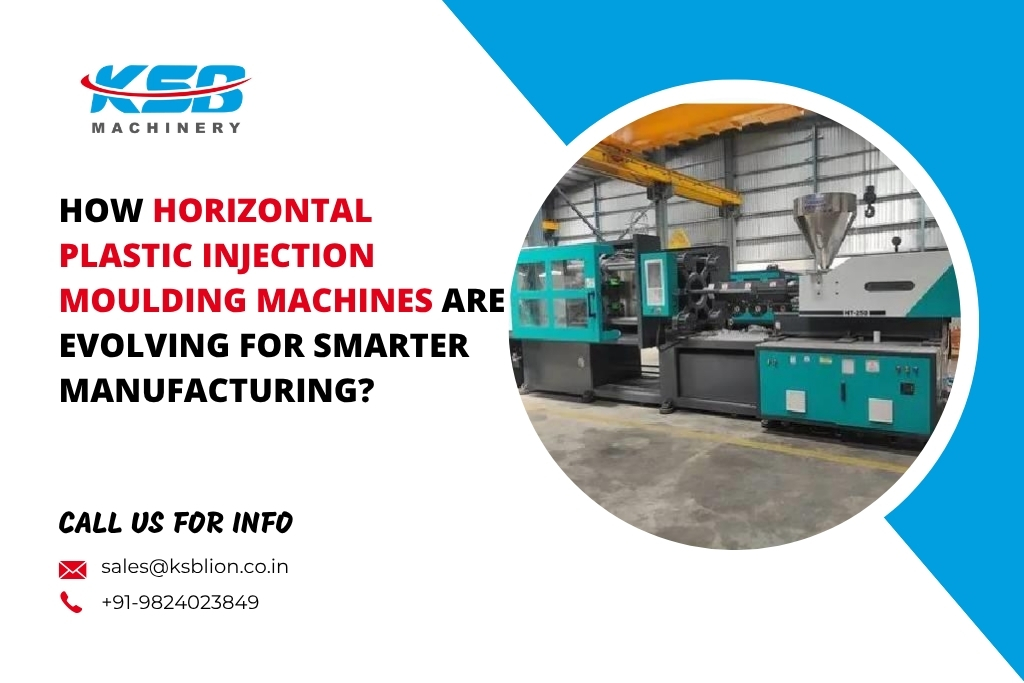
Plastic manufacturing is changing quickly.Manufacturers are under pressure to produce consistent components while controlling energy use, reducing material waste, improving cycle times, and maintaining reliable production.This is increasing interest in modern Horizontal Plastic Injection Moulding Machines that combine established injection moulding principles with automation, digital controls, servo technology, and process monitoring.
A horizontal machine can be suitable for a wide range of production applications, but its effectiveness depends on the machine configuration, mould, material, process settings, and production requirements.Ksblion is associated with plastic injection moulding machinery for manufacturers evaluating solutions for modern production environments.
Why Horizontal Injection Moulding Remains Important in Modern Factories?
Horizontal injection moulding machines continue to play an important role in plastic manufacturing because their configuration can support automated and repeatable production.They are used across industries that manufacture large volumes of plastic components.
Applications can include:
- Automotive components
- Electrical and electronic parts
- Consumer products
- Industrial components
- Packaging products
One reason for their continued relevance is their compatibility with automated part removal and material-handling systems.A production line can be configured around the moulding machine so that parts move from moulding to inspection, trimming, assembly, or packaging with less manual intervention.
The machine itself is only one part of the production system.Mould design, resin selection, cooling, process parameters, auxiliary equipment, and maintenance all influence the final result.
What Makes Modern Horizontal Injection Moulding Machines More Efficient?
Modern machines are increasingly designed around better control of machine movements and production parameters.Traditional machine functions remain important, but manufacturers now have access to technologies that can provide more precise control.
These can include:
- Servo-driven systems
- Digital controllers
- Sensors
- Automated material feeding
- Production monitoring
- Process data collection
The objective is not simply to make the machine more technologically complex.The real value comes from using technology to improve control, repeatability, efficiency, and production visibility.
Servo Motor Technology
Servo technology is an important development in modern injection moulding.A servo-driven system can provide controlled motor operation according to the machine’s operating requirements.Depending on machine design and production conditions, servo systems can help reduce unnecessary energy consumption during periods when full motor output is not required.They can also provide controlled movement and repeatability.
Potential advantages include:
- Controlled machine movement
- Better response to production demands
- Reduced idle energy use
- Repeatable operation
- Improved process control
Actual energy performance depends on the machine configuration, material, mould, cycle, and operating conditions.Therefore, manufacturers should evaluate machine performance based on their actual production requirements rather than relying only on general energy-saving claims.
How Automation Is Changing Horizontal Injection Moulding?
Automation is becoming a major part of modern plastic production.A horizontal injection moulding machine can be integrated with equipment that handles different stages of production.
Examples include:
- Robotic part removal
- Automatic material feeding
- Conveyors
- Vision inspection
- Automated packaging
- Production monitoring systems
Automation can reduce the amount of manual intervention required during repetitive production tasks.It can also help manufacturers create more consistent production routines.
For example, a robot can remove moulded components according to a programmed sequence rather than relying on manual removal for every cycle.This can be particularly useful for high-volume production.
However, automation should be designed around the product and production process.A simple application may require limited automation, while a complex high-volume line may benefit from several integrated systems.
Why Process Control Matters for Plastic Part Quality?
Plastic injection moulding requires control over several variables.Changes in temperature, pressure, speed, cooling, or material behaviour can influence the final component.
Important process parameters can include:
- Injection pressure
- Injection speed
- Holding pressure
- Melt temperature
- Mould temperature
- Cooling time
- Overall cycle time
Stable process conditions can help reduce unwanted variation between production cycles.This is especially important when manufacturing components with tight dimensional or visual requirements.
Why Energy Efficiency Matters in Plastic Manufacturing?
Injection moulding machines can operate for long production periods.Even relatively small differences in energy consumption can become significant over extended operating hours.
This is why manufacturers are increasingly evaluating energy performance when selecting machinery.
Modern horizontal machines may incorporate technologies such as servo drives, efficient hydraulic systems, improved motor control, and optimised machine operation.Energy consumption can also be influenced by production decisions.For example, unnecessary machine idle time, inefficient cycle settings, poor maintenance, or excessive scrap can increase the overall resource requirement of a production operation.
What Manufacturers Should Consider Before Choosing a Horizontal Injection Moulding Machine?
Selecting a machine should begin with the product and production requirements.The correct machine depends on the mould, material, component size, production volume, and desired cycle time.
Important considerations include:
Clamping Force and Mould Size
The machine’s clamping capacity needs to match the mould and application.The mould dimensions must also fit within the machine’s available space and specifications.
Injection Capacity
Shot size, injection pressure, material type, and component weight should be considered together.A machine should have suitable injection capacity for the intended product rather than simply being selected based on nominal machine size.
Production Requirements
Manufacturers should evaluate:
- Expected production volume
- Required cycle time
- Material
- Part geometry
- Automation level
- Quality requirements
- Future production expansion
This approach helps manufacturers select equipment that fits their actual production needs.
The Role of Horizontal Injection Moulding in Sustainable Manufacturing
Sustainability is becoming increasingly relevant to plastic manufacturers.Energy-efficient equipment can contribute to lower energy consumption, but machinery is only one part of a broader sustainability strategy.
Manufacturers can also focus on:
- Reducing production scrap
- Optimising material usage
- Improving process stability
- Recycling suitable production waste
- Preventive machine maintenance
- Extending equipment service life
Stable injection moulding processes can help reduce rejected parts and unnecessary material consumption.However, sustainability outcomes depend on the entire production system.Material selection, product design, mould design, processing conditions, energy sources, and waste-management practices all matter.
Future Trends in Horizontal Plastic Injection Moulding
The future of Horizontal Plastic Injection Moulding Machines is closely connected with automation, process intelligence, energy management, and connected manufacturing.
Manufacturers are looking for equipment that can produce consistent parts while giving production teams better control over machine performance.The next stage of development is not simply about adding more technology.It is about using technology where it can solve practical production problems.
Emerging Trends in Horizontal Injection Moulding
Smarter Process Monitoring
Machine monitoring is becoming more important as manufacturers seek better visibility into production.Sensors and digital controls can help collect information about machine operation, cycle performance, alarms, and process conditions.
This information can help production teams identify unusual changes before they become larger production problems.For example, unexpected changes in cycle time or machine behaviour can indicate that an inspection or maintenance check may be necessary.
The objective is to move from reactive production management toward more data-supported decision-making.
Greater Use of Robotics
Robotic automation is expected to remain important in high-volume plastic manufacturing.
Robots can perform repetitive tasks such as:
- Removing moulded components
- Separating runners
- Transferring parts
- Placing components for inspection
- Supporting packaging operations
The combination of a Horizontal Plastic Injection Moulding Machine and robotics can create a more consistent production sequence.Automation can also reduce manual handling of hot or freshly moulded components.The appropriate automation level depends on the product, production volume, cycle time, and factory layout.
Energy Management Will Remain a Key Focus
Energy efficiency is likely to remain a major consideration for plastic manufacturers.
Servo-driven systems, improved motor control, efficient hydraulic technology, and better process optimisation can all contribute to improved machine efficiency depending on the specific configuration.However, energy consumption should be evaluated under actual production conditions.
Manufacturers should consider machine power consumption alongside:
- Cycle time
- Part weight
- Production volume
- Scrap rate
- Machine utilisation
- Auxiliary equipment
This gives a more useful picture of overall production efficiency.
Digital Manufacturing and Predictive Maintenance
Connected machines can provide production information that supports maintenance planning.Instead of waiting for a component to fail, manufacturers can monitor operating conditions and identify signs that may require attention.This approach can support predictive or condition-based maintenance where the available data and equipment allow it.
Potential benefits include:
- Better maintenance planning
- Reduced unexpected downtime
- Improved machine availability
- Better spare-parts planning
- Longer equipment service life
Predictive maintenance is not automatic simply because a machine has sensors.It requires appropriate monitoring, data interpretation, maintenance procedures, and skilled personnel.
Choosing a Horizontal Injection Moulding Machine for Future Production
Manufacturers should think beyond today’s production requirements.A machine selected for a current product may later need to support higher production volumes or greater automation.
Before selecting equipment, manufacturers should consider:
1. Product Requirements
Evaluate part dimensions, weight, material, geometry, tolerance requirements, and surface-finish expectations.
2. Mould Requirements
Check mould dimensions, clamping requirements, ejection arrangement, cooling needs, and available machine space.
3. Production Volume
Estimate current production requirements and potential future demand.
4. Automation
Determine whether the production line may require robots, conveyors, inspection systems, or automatic material handling.
5. Process Control
Consider the level of monitoring and parameter control needed for the product.
6. Energy Performance
Compare machine efficiency under relevant operating conditions rather than relying only on headline specifications.
Conclusion
The Horizontal Plastic Injection Moulding Machine continues to have an important role in modern plastic manufacturing.Its future is being shaped by several major developments, including servo technology, automation, machine monitoring, robotics, energy management, and Industry 4.0 connectivity.For manufacturers, these technologies can support better production visibility, process consistency, and resource management when correctly matched to the application.However, technology should always serve a clear production objective.The right machine depends on the product, mould, material, production volume, cycle requirements, quality expectations, and automation strategy.
Ksblion can be considered by manufacturers exploring modern injection moulding machinery for evolving production requirements.The strongest machine-selection decisions begin with a clear understanding of the application and then match the machine’s capabilities to that requirement.