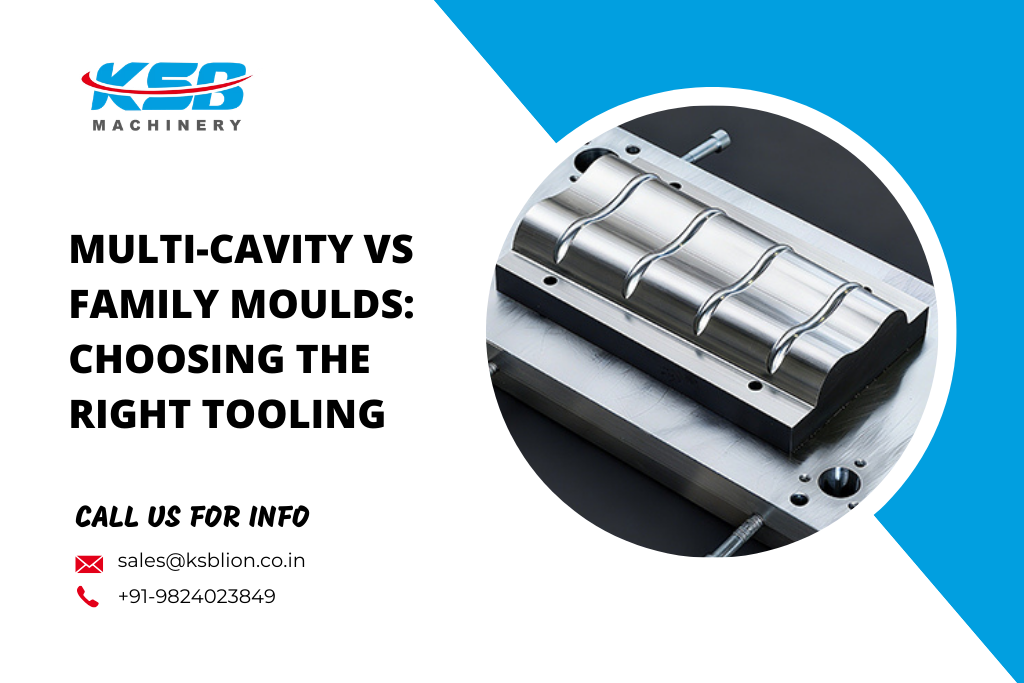
In plastic manufacturing, tooling decisions directly impact cost, quality, and production efficiency. One of the most common debates manufacturers face is multi-cavity vs family moulds. Both mould types play a vital role in plastic injection moulding, but choosing the wrong one can lead to higher scrap rates, imbalanced production, or unnecessary tooling costs.
This guide offers a clear injection mould tooling comparison to help manufacturers make informed decisions when choosing the right injection mould for their application.
What Is a Multi-Cavity Mould?
A multi-cavity mould produces multiple identical parts in a single injection cycle. Each cavity has the same shape and dimensions, allowing manufacturers to increase output without increasing cycle time.
Key Advantages of Multi-Cavity Moulds
- High production efficiency for large volumes
- Consistent part quality across all cavities
- Lower cost per part at scale
- Ideal for automation and high-speed manufacturing
Multi-cavity moulds are commonly paired with a high-tonnage Plastic Injection moulding Machine to ensure balanced filling and uniform pressure across all cavities.
Common Applications
- Bottle caps
- Medical disposables
- Packaging components
- Automotive fasteners
What Is a Family Mould?
A family mould produces different parts in a single mould cycle. These parts are typically used together in a final assembly, such as a housing and its cover.
Key Advantages of Family Moulds
- Reduced tooling cost compared to multiple individual moulds
- Faster time-to-market for new products
- Ideal for low-to-medium production volumes
- Simplified inventory management
Family moulds are often selected when manufacturers want flexibility and cost savings during early product development.
Multi-Cavity vs Family Moulds: Injection Mould Tooling Comparison
| Factor | Multi-Cavity Moulds | Family Moulds |
| Part Type | Identical parts | Different parts |
| Production Volume | High | Low to medium |
| Tooling Cost | Higher upfront | Lower upfront |
| Cycle Balance | Excellent | Can be challenging |
| Scrap Risk | Low | Higher if imbalance occurs |
| Scalability | Very high | Limited |
This injection mould tooling comparison highlights that neither option is universally better-each serves a specific manufacturing goal.
Key Factors When Choosing the Right Injection Mould
1. Production Volume
If you need millions of identical components annually, multi-cavity moulds deliver unmatched efficiency. Family moulds, on the other hand, are better for smaller batches or prototype-to-production transitions.
2. Part Complexity and Size
Different-sized parts in a family mould can lead to uneven filling and cooling. Multi-cavity moulds eliminate this issue by maintaining uniform geometry across cavities.
3. Material Flow and Balance
Family moulds require careful runner and gate design to ensure consistent material flow. An experienced Injection moulding Machine Manufacturer can help optimize machine parameters to minimize imbalance.
4. Quality Requirements
For industries like medical, automotive, or electronics, consistency is critical. Multi-cavity moulds offer better repeatability and tighter tolerances.
5. Budget and Lead Time
Family moulds are often chosen when tooling budgets are limited or when faster development cycles are required.
Role of the Plastic Injection Moulding Machine
Regardless of mould type, machine capability plays a crucial role. A modern Plastic Injection moulding Machine ensures:
- Precise pressure control
- Uniform clamping force
- Stable temperature regulation
- Reduced cycle time variability
Advanced machines with servo-driven systems and smart controls are particularly beneficial when running multi-cavity moulds at high output levels.
How an Injection Moulding Machine Manufacturer Adds Value?
An experienced Injection moulding Machine Manufacturer does more than supply equipment. They help manufacturers:
- Match mould design with machine tonnage and shot capacity
- Optimize cycle times for multi-cavity tools
- Reduce imbalance risks in family moulds
- Improve energy efficiency and process stability
Machine-mould compatibility is often the deciding factor in achieving consistent quality and long-term cost savings.
Which Mould Should You Choose?
Choose a multi-cavity mould if:
- You require high-volume production
- All parts are identical
- Consistency and automation are priorities
Choose a family mould if:
- You are producing multiple related components
- Volumes are moderate
- Tooling cost and speed-to-market matter
Ultimately, choosing the right injection mould depends on production goals, part design, and machine capability.
Final Thoughts
The decision between multi-cavity vs family moulds is not just about tooling-it’s about aligning design, production volume, and machinery for optimal performance. By conducting a detailed injection mould tooling comparison and working closely with a reliable Injection moulding Machine Manufacturer, manufacturers can achieve better quality, lower costs, and scalable production.
Making the right tooling choice today ensures long-term manufacturing success tomorrow.