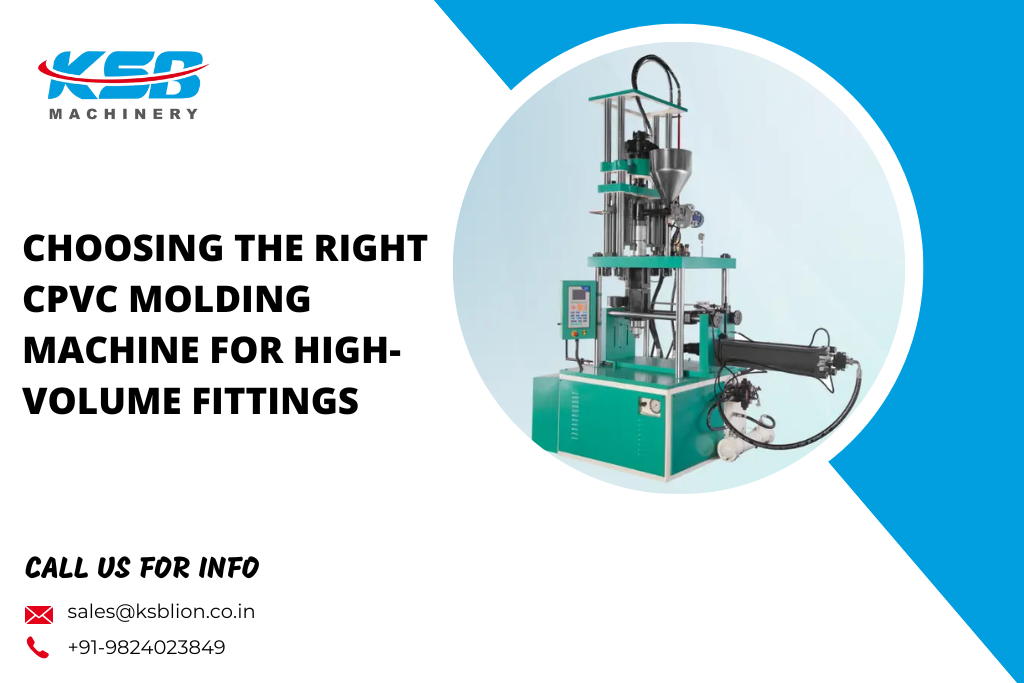
As demand for CPVC pipe fittings continues to rise in plumbing, industrial, and construction sectors, manufacturers are under pressure to increase output while maintaining consistent quality. For businesses aiming to expand high-volume CPVC pipe fittings production, selecting the right CPVC Injection Molding Machine becomes a critical decision. The machine capacity directly affects product consistency, cycle time, energy usage, and long-term profitability.
This detailed guide will help industry owners understand how to choose the correct CPVC injection molding machine capacity, avoid common selection mistakes, and match machine features with production goals.
Why Machine Capacity Matters for CPVC Manufacturing?
Unlike standard plastics, CPVC requires carefully controlled melt temperatures, stable pressure, and precise molding conditions. Choosing the right machine capacity ensures:
- Efficient melting of CPVC material
- Uniform flow into complex pipe fitting molds
- Reduced product defects
- Longer mold life
- Faster cycle time for mass production
A machine with inadequate tonnage or barrel capacity can compromise product quality and slow down operations, while an oversized machine leads to unnecessary energy consumption and higher costs.
Key Capacity Factors for CPVC Injection Molding Machines
1. Clamping Force Requirements
The clamping force determines how tightly the mold is held together during injection. For CPVC pipe fittings, which often require thick-walled or pressure-rated designs, a higher clamping force ensures no flash or deformation.
Typical fittings — elbows, tees, couplers, and adaptors – need accurate pressure control and mold stability.
Tip: Calculate mold projected area × pressure factor to determine minimum tonnage.
A reliable CPVC Injection Molding Machine should maintain stable clamping throughout the production cycle.
2. Injection Unit Size & Barrel Capacity
The barrel capacity must match the shot size required for a single part or multi-cavity mold. CPVC is sensitive to overheating, so barrel size greatly influences melt stability.
If the barrel is too large, material remains inside for too long, risking thermal degradation. If too small, incomplete filling may occur.
Understanding shot weight and molding volume is essential for selecting proper CPVC injection molding machine capacity.
3. Screw Design for CPVC Material
CPVC requires a specific screw structure that ensures:
- Uniform heating
- Minimal shear
- Proper plasticizing
- Smooth material flow
A general-purpose screw may not deliver the required consistency for CPVC. Many advanced CPVC injection molding machine manufacturers today offer screw designs tailored for CPVC and other engineering plastics.
4. Temperature Control Precision
CPVC has a narrow processing range. Proper temperature control across the barrel and mold is crucial to avoid poor surface finish, burns, or brittleness.
The machine should include:
- Multi-zone temperature control
- Real-time monitoring
- Stable heating bands
- Efficient cooling cycles
These ensure reliable and repeatable production.
5. Injection Pressure & Speed
Industrial-grade CPVC fittings often need high injection pressure due to thick walls or complex flow paths inside the mold.
The machine must support:
- High-pressure injection
- Adjustable speed profiles
- Smooth transition between injection and holding
- Precision control to reduce internal stress
Selecting the right pressure range is a core part of any CPVC molding machine selection guide.
Matching Machine Capacity With High-Volume CPVC Production Goals
1. Multi-Cavity Molding
High-volume manufacturers often use multi-cavity molds to increase output. This requires:
- Higher clamping force
- Increased injection volume
- Consistent heating and cooling
Choosing a machine that supports multi-cavity molds reduces cycle time and improves profitability.
2. Large Part Production
For bigger fittings like reducers, ball valves, or custom industrial fittings, machine capacity must be aligned with part weight and size.
Larger barrels and higher tonnage machines are recommended for smooth production.
3. Automated Production Lines
Many factories now integrate automation features such as:
- Robotics
- Auto-de-gating
- Automated mold cooling
- Conveyor-based part removal
Ensure the machine supports automation compatibility and accurate synchronization.
Common Mistakes Industry Owners Should Avoid
- Choosing machines based only on tonnage without considering barrel size
- Overlooking temperature control accuracy
- Ignoring screw design optimized for CPVC
- Buying machines with insufficient injection pressure
- Selecting oversized machines that increase power consumption
Careful analysis prevents production bottlenecks and reduces long-term operating costs.
KSBLION – A Trusted Name in Injection Molding Machine Manufacturing
When it comes to reliable, high-performance machinery for CPVC production, KSBLION has built a strong reputation among injection molding machine manufacturers. Their machines are designed to meet the demanding requirements of CPVC material-offering advanced temperature control, efficient screw design, precise pressure management, and stable clamping performance.
Manufacturers choosing KSBLION benefit from:
- Machines engineered specifically for CPVC and engineering plastics
- High durability components suitable for long production cycles
- Modular configurations to match varied production needs
- Strong customer support and service assistance
- Energy-efficient systems designed for cost-effective operations
These features make KSBLION a preferred brand for businesses seeking dependable machinery for high-volume CPVC pipe fittings production.
Final Thoughts
Selecting the right CPVC injection molding machine capacity is one of the most important decisions for any CPVC fittings manufacturer. The correct capacity ensures efficiency, product consistency, and long-term savings. By understanding critical specifications—tonnage, barrel size, injection pressure, screw design, and automation compatibility-you can choose a machine that fully supports your production goals.
Brands like KSBLION offer advanced solutions tailored for modern industry needs, making them a strong choice among CPVC injection molding machine manufacturers for businesses aiming to scale and optimize their operations.